
Why the Mirror Can Make Real Progress Feel Fake
Why can't I see my weight loss in the mirror, even when the scale and the clothes agree? Daily exposure hides the gradient. If you see your body every day, the mirror is often the last place that will give you reassurance. That does not mean progress is not happening. It means the mirror is a terrible historian.
 By pkang6 min read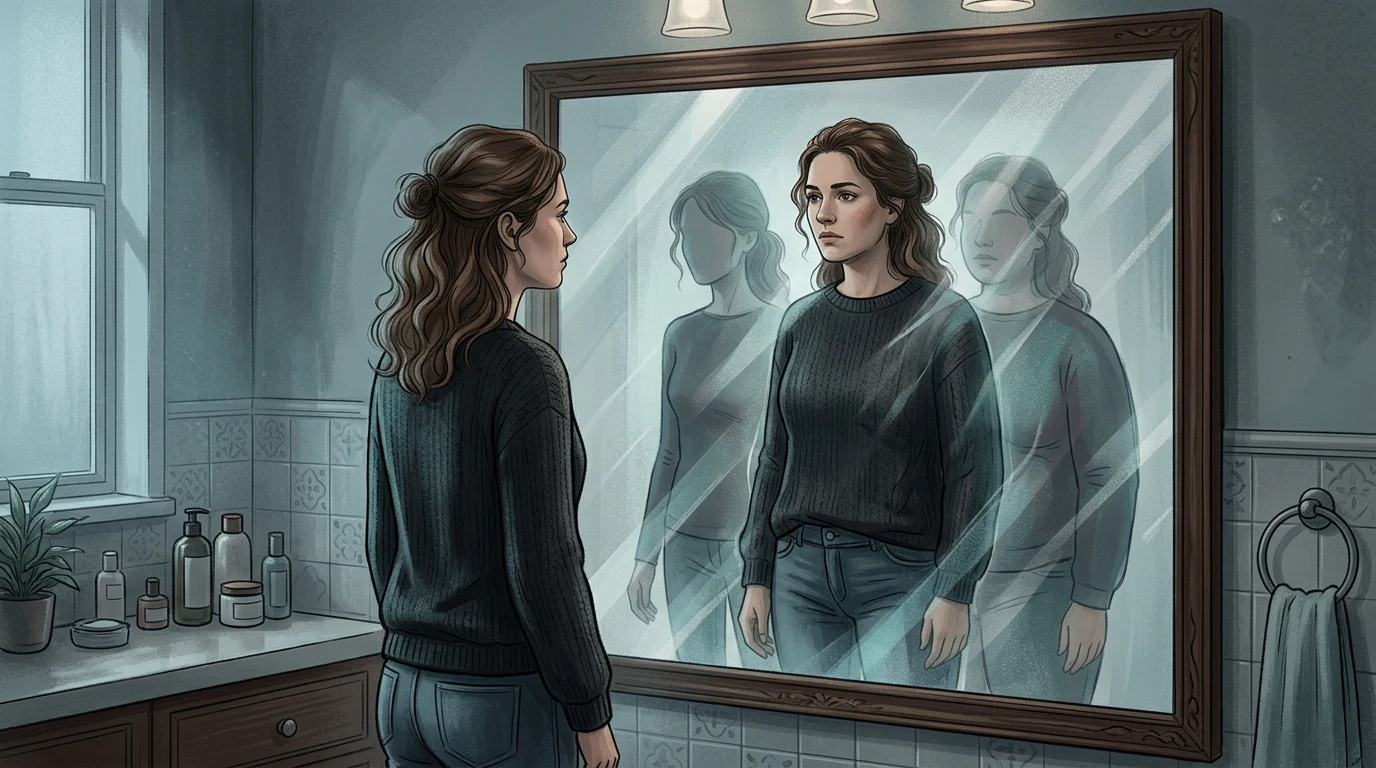
Why can't I see my weight loss in the mirror, even when the scale and the clothes agree? Daily exposure hides the gradient. The mirror is one of the worst places to look for reassurance during body change.
Not because it always lies. But because it adapts too well.
When you see your body every day, small differences stop feeling like differences. That is why people can be making real progress and still feel stuck.
This is where a lot of diets actually fail. Not in physiology. In interpretation.
Why can't I see my weight loss in the mirror?
Because seeing your body daily makes gradual change invisible. The eyes adapt fast. The body changes slowly. That combination normalizes change before your perception catches up. The mirror also only shows one moment under one mood, and one moment is easy to misread. Photos across weeks beat daily mirror checks.
The Mirror Only Shows One Emotional Frame
The mirror does not show trend. It does not show context. It does not show comparison. It shows one moment.
And that one moment is easy to misread.
If you are flat, tired, bloated, stressed, underslept, or disappointed, the mirror becomes an amplifier for whatever story you are already telling yourself.
That is why the same body can look “better” one day and “worse” the next, even when almost nothing meaningful has changed.
Daily Exposure Makes Change Harder To Notice
People underestimate how much familiarity distorts perception.
The body changes slowly. The eyes adapt quickly. That is a bad combination.
When the change is gradual, your brain normalizes it before your confidence catches up. So even when the process is working, the visible reward can feel delayed.
That delay is dangerous. Because once you start thinking nothing is happening, the next bad meal, bad weigh-in, or bad mirror day suddenly feels like proof that the whole thing failed.
This Is Why Progress Often Feels Fake In The Middle
The beginning is clear. You know you want change. You know why you started.
The ending is also clear. You can look back and say, yes, that was real.
But the middle is where doubt lives. The middle is subtle. The middle looks ordinary. The middle is easy to dismiss.
That is exactly why so many people quit there. Not because nothing is happening. Because they cannot trust what is happening.
What Works Better Than The Mirror
If you want to judge progress more honestly, you need better evidence than one emotional look in the bathroom mirror.
- progress photos across real time gaps
- weekly comparison, not daily obsession
- stable conditions as often as possible
- a visual record you can revisit
One photo is still just one moment. But repeated photos become a story. And stories are harder to distort than moods.
One Moment Is Data. A Record Is Evidence
A single look in the mirror is data. A stored visual timeline is evidence.
Evidence matters because it protects you from panic. It keeps you from overreacting to one bad day. It reminds you that change can be real before it feels dramatic. And it gives you something more stable than memory to rely on.
That Is Why Weekly Check-Ins Matter
I care much more about weekly proof than daily reassurance. Daily reassurance is fragile. Weekly proof compounds.
When you check in on a weekly cadence, you give your body enough time to show direction. That direction is what keeps people going.
Not hype. Not discipline theater. Not pretending doubt never shows up. Just better evidence.
If the mirror feels discouraging right now, that does not automatically mean the process is failing. It may just mean you are too close to the change to see it clearly yet.
That is why one of the best things you can do is stop asking the mirror to tell the whole story. Build a record instead. One scan is a number. Weekly check-ins are proof.
Frequently Asked Questions
How long until the mirror starts showing the change?+
For most people, three to six months after meaningful loss before the daily mirror reliably reflects it. Other people will notice first because they have weeks or months of gap to compare across. Your daily exposure is the thing hiding the change from you.
Can the mirror lie even when the scale is moving?+
Yes. Lighting, posture, time of day, sleep, and mood all change how the same body looks. The mirror amplifies whatever story you are telling yourself that morning. A good mood gets a generous read. A bad mood gets a punishing one. Same body.
Are progress photos more honest than the mirror?+
Yes, when taken under matched conditions: same room, same time, same posture, same light. Single photos can still lie, so compare in groups of four across months, not single shots week to week. The four-photo comparison removes most of the noise.
Why does the back of my body change first?+
For many people the back has less stubborn fat buffer than the front, so it tightens earlier. You also never see your back in the daily mirror, so the change registers when someone takes a photo from behind. Take one rear photo every two weeks under matched conditions.
Is feeling 'phantom fat' after weight loss normal?+
Common, yes. The internal map of your body lags the physical change by months. People describe still reaching for old clothing sizes, still flinching at mirrors, still feeling like the older body. The perception updates gradually, pulled forward by external evidence and time.
Next step
Start with one body check-in.
If the mirror is noisy right now, use one scan as a baseline and start building a visual record you can actually trust.
Try the free body scan